




Introduction
A flat maxilla, also known as a recessed maxilla or maxillary hypoplasia, refers to an underdeveloped upper jawbone that lacks normal forward growth. The maxilla is one of the most important facial bones because it forms the upper jaw, supports the cheeks, contributes to the eye sockets, and helps shape the nasal cavity and hard palate.
When the maxilla does not develop properly, it can affect both facial appearance and essential functions such as breathing, chewing, speaking, and sleeping. Individuals with a flat maxilla often have a flatter midface, prominent lower jaw, and bite alignment issues. In severe cases, it may contribute to airway obstruction and sleep apnea.
Understanding the causes, symptoms, diagnosis, and treatment options for a flat maxilla can help individuals make informed decisions about their oral and facial health.
What Is a Flat Maxilla?
Definition of a Flat Maxilla
A flat maxilla is a condition where the upper jaw fails to project forward normally. Medical professionals often refer to this condition as maxillary hypoplasia. Unlike a normally developed maxilla that supports balanced facial proportions, a recessed maxilla causes the middle portion of the face to appear sunken or underdeveloped.
The maxilla plays a critical role in facial harmony. When it is positioned too far back, the lower jaw may appear overly prominent even if it is normal in size. This imbalance can create both cosmetic and functional concerns.
Anatomy of the Maxilla
The maxilla is a paired facial bone located in the center of the face. It contributes to several important structures, including:
- Formation of the upper jaw
- Support of the cheekbones
- Floor of the eye sockets
- Side walls of the nasal cavity
- Hard palate of the mouth
Within the maxilla lies the maxillary sinus, the largest of the paranasal sinuses. The bone also contains the alveolar process, which supports the upper teeth.
Functions of the Maxilla
The maxilla performs several essential functions:
- Supports and anchors upper teeth
- Maintains facial balance and aesthetics
- Assists proper chewing and speech
- Supports normal nasal airflow
- Contributes to healthy airway development
Because of these functions, abnormalities in maxillary growth can affect both appearance and overall health.
How to Identify a Flat or Recessed Maxilla
Common Facial Characteristics
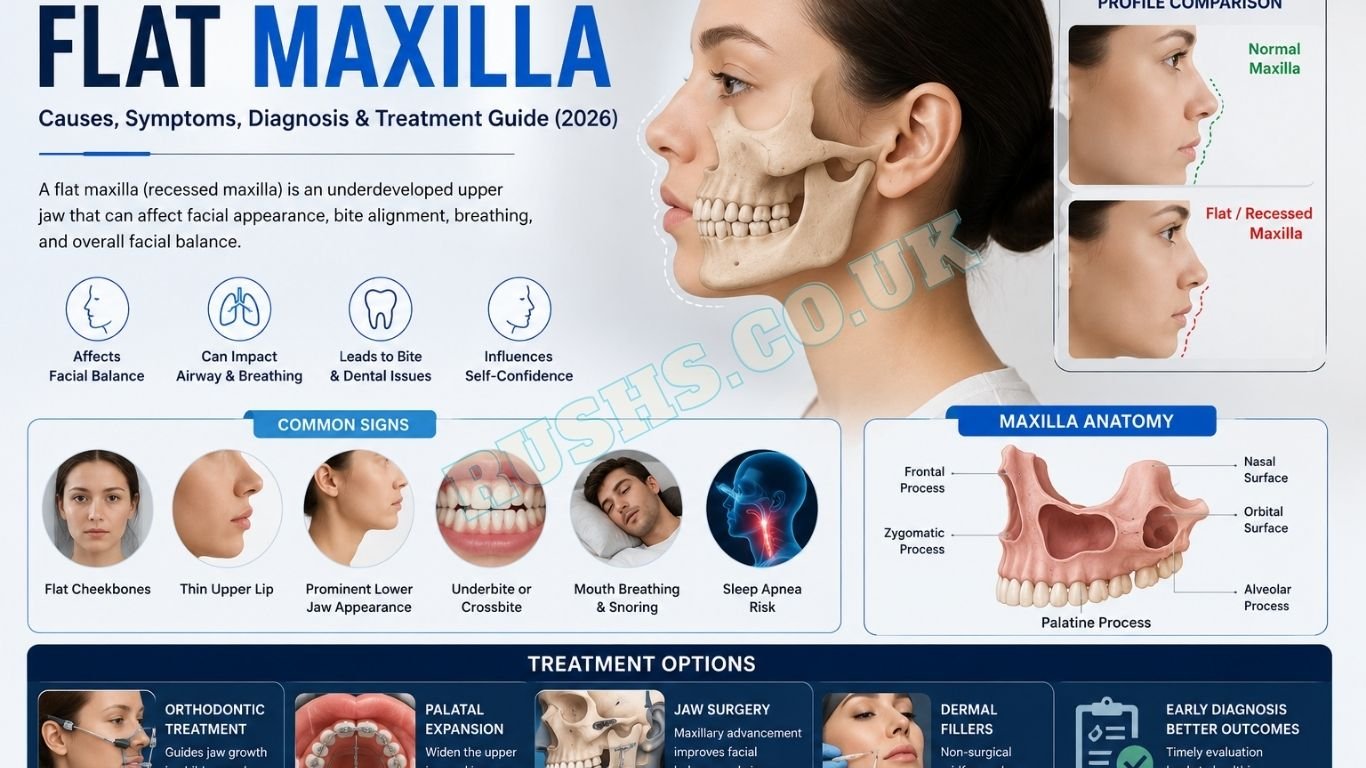
People with a flat maxilla often display distinctive facial features, including:
- Flat or underdeveloped cheekbones
- Midface deficiency
- Thin upper lip
- Under-eye hollowness
- Long facial appearance
- Prominent nose projection
- Apparent protrusion of the lower jaw
These characteristics vary depending on the severity of maxillary recession.
Side Profile Signs
The side profile often reveals a recessed upper jaw more clearly than the front view. Common profile indicators include:
- Retruded upper jaw
- Concave facial profile
- Reduced cheek projection
- Prominent chin appearance
Dental Indicators
Dental signs frequently accompany maxillary hypoplasia, including:
- Underbite
- Crossbite
- Crowded teeth
- Malocclusion (misaligned bite)
Orthodontists often identify maxillary deficiencies during routine dental evaluations.
Symptoms Associated with a Flat Maxilla
Dental Symptoms
An underdeveloped maxilla can cause several dental problems:
- Teeth grinding (bruxism)
- Difficulty chewing food
- Uneven tooth wear
- Jaw discomfort
- Bite instability
Airway and Breathing Problems
Since the maxilla forms part of the nasal airway, recession may contribute to:
- Mouth breathing
- Chronic nasal congestion
- Snoring
- Sleep-disordered breathing
- Obstructive sleep apnea
Restricted airway space is one of the most significant health concerns associated with severe maxillary deficiency.
Speech and Cosmetic Concerns
Some individuals experience:
- Speech articulation difficulties
- Tongue posture abnormalities
- Swallowing issues
- Facial asymmetry
- Weak midface projection
These issues may impact self-confidence and quality of life.
What Causes a Flat Maxilla?
Genetic Factors
Genetics play the largest role in facial development. Research suggests that facial structure is highly hereditary. If one or both parents have a recessed midface, their children may inherit similar facial characteristics.
Developmental Conditions
Several medical conditions may contribute to maxillary underdevelopment, including:
- Maxillofacial dysostosis
- Pierre Robin Sequence
- Angelman Syndrome
- Cleft lip and palate
These conditions can affect normal facial growth during childhood.
Environmental Influences
Certain environmental factors may influence facial development:
- Childhood facial trauma
- Chronic mouth breathing
- Enlarged tonsils or adenoids
- Poor oral posture habits
Long-term airway problems during developmental years may alter facial growth patterns.
Fetal and Congenital Factors
Prenatal factors such as Fetal Alcohol Syndrome and congenital developmental abnormalities can also interfere with normal maxillary growth.
Flat Maxilla vs Normal Maxilla
A normal maxilla provides adequate forward projection of the midface, proper dental alignment, and healthy airway dimensions. In contrast, a flat maxilla often presents with:
- Reduced midface projection
- Smaller nasal airway
- Poor bite alignment
- Increased risk of breathing difficulties
From an aesthetic perspective, a normal maxilla contributes to facial harmony and balanced proportions, while a recessed maxilla may create an imbalanced profile.
Health Risks of a Recessed Maxilla
Airway Restriction
A recessed maxilla can reduce nasal cavity volume, making breathing less efficient. Individuals may compensate through mouth breathing, which can negatively affect sleep quality.
Sleep Apnea Risk
Research has linked maxillary deficiency to obstructive sleep apnea. Reduced airway space can increase the likelihood of airway collapse during sleep, leading to interrupted breathing episodes.
TMJ Disorders
Jaw misalignment may place additional stress on the temporomandibular joint (TMJ), causing:
- Jaw pain
- Clicking sounds
- Headaches
- Facial muscle tension
Dental Complications
Poor jaw alignment can result in:
- Tooth wear
- Gum recession
- Bite instability
- Increased orthodontic challenges
Understanding Maxillary Anatomy
The maxillary body contains four major surfaces:
- Orbital surface
- Nasal surface
- Anterior surface
- Infratemporal surface
The maxilla also includes four important processes:
Frontal Process
Connects the maxilla to the frontal and nasal bones.
Zygomatic Process
Forms part of the cheekbone region.
Palatine Process
Creates most of the hard palate.
Alveolar Process
Contains the tooth sockets for upper teeth.
The maxillary sinus is located within the body of the maxilla and plays a role in facial structure, airflow, and sinus drainage.
How Doctors Diagnose a Flat Maxilla
Diagnosis usually involves several steps:
Physical Examination
Specialists evaluate:
- Facial symmetry
- Midface projection
- Bite relationship
- Airway function
Dental and Orthodontic Evaluation
Orthodontists perform occlusion analysis and cephalometric measurements to assess jaw positioning.
Imaging Tests
Advanced imaging may include:
- Dental X-rays
- CBCT scans
- CT scans
- 3D facial imaging
Sleep Studies
When breathing problems are suspected, sleep studies help identify sleep apnea and airway obstruction.
Treatment Options for Flat Maxilla
Orthodontic Treatment
Children and adolescents may benefit from:
Reverse Pull Facemask
Encourages forward growth of the upper jaw during developmental years.
Palatal Expansion
Widens the upper jaw and may improve nasal airflow.
Braces and Aligners
Correct bite problems and improve tooth alignment.
Orthognathic Surgery
Adults with severe maxillary deficiency may require surgical correction.
Maxillary Advancement Surgery
Moves the upper jaw forward to improve facial balance and airway function.
Le Fort I Osteotomy
A common surgical technique used to reposition the maxilla.
Anterior Maxillary Distraction
Used in selected severe cases, especially patients with cleft-related deformities.
Dermal Fillers
For cosmetic enhancement, dermal fillers can temporarily improve cheek projection and midface volume. However, fillers do not correct the underlying skeletal deficiency.
Does Mewing Fix a Flat Maxilla?
What Is Mewing?
Mewing involves maintaining the tongue against the roof of the mouth to encourage proper oral posture.
Scientific Evidence
Although proper tongue posture may support oral health, there is currently limited scientific evidence showing that mewing can significantly move or remodel the maxilla in adults.
Common Myths About Face Pulling
Many online claims suggest dramatic facial changes through face pulling techniques. However, orthodontists and maxillofacial surgeons generally agree that substantial skeletal changes require orthodontic treatment or surgery.
Can a Flat Maxilla Be Prevented?
Early intervention can help reduce complications.
Early Childhood Monitoring
Regular dental examinations can identify developmental concerns before they worsen.
Addressing Mouth Breathing Early
Treating allergies, enlarged adenoids, and nasal obstruction may support healthier facial growth.
Orthodontic Intervention During Growth
Growth modification treatments are often most effective before skeletal maturity.
Living with a Flat Maxilla
Many people with mild maxillary recession live healthy lives without treatment. However, those experiencing breathing problems, bite issues, or significant cosmetic concerns should seek professional evaluation.
Maintaining airway health, quality sleep, and proper dental care remains important regardless of treatment choices.
Frequently Asked Questions (FAQs)
Is a flat maxilla the same as maxillary hypoplasia?
Yes. Flat maxilla and maxillary hypoplasia generally describe underdevelopment of the upper jaw.
Can adults correct a recessed maxilla?
Yes. Surgical procedures such as maxillary advancement can correct severe cases.
Does a flat maxilla cause sleep apnea?
It can increase the risk by reducing airway space.
Can braces fix a flat maxilla?
Braces improve tooth alignment but cannot significantly reposition adult jawbones.
Is surgery the only permanent solution?
For severe skeletal deficiencies in adults, surgery is usually the most effective long-term solution.
Does mewing move the maxilla?
Current scientific evidence does not support major skeletal changes from mewing alone.
What age is best for treatment?
Early childhood and adolescence are ideal because facial bones are still growing.
Can fillers improve a flat maxilla?
Yes, but only cosmetically and temporarily.
Conclusion
A flat maxilla is more than a cosmetic concern. Because the maxilla influences facial appearance, dental alignment, breathing, speech, and airway health, underdevelopment can have far-reaching effects. While genetics are often the primary cause, developmental and environmental factors may also contribute.
Modern treatment options range from orthodontic appliances and palatal expansion to advanced orthognathic surgery and cosmetic fillers. Early diagnosis offers the best opportunity for successful intervention, particularly in growing children. Anyone experiencing bite problems, breathing difficulties, or concerns about facial structure should consult an orthodontist, oral surgeon, or maxillofacial specialist for a comprehensive evaluation.